


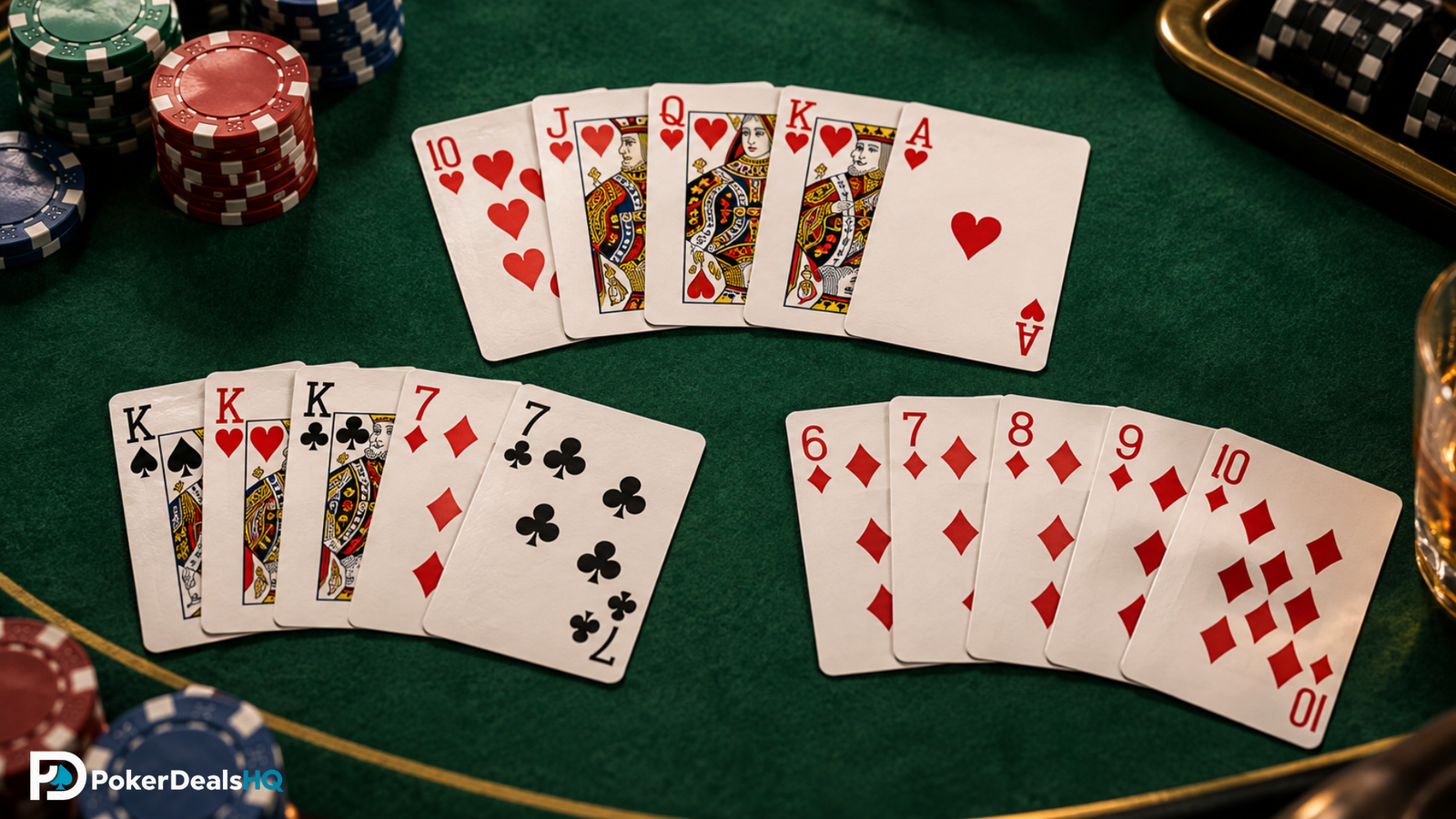
Understanding the hierarchy of poker hands rankings is essential for any beginner. A good knowledge base regarding which poker hands beat which allows you to evaluate your holdings and compare them against those held by your opponents.
For example, a frequently asked question is whether a flush or a straight wins. Yes, it does, although you will discover many more combinations and additional information below.
This article contains an overview of ten basic poker hand rankings used in Texas Hold’em with sample cards and rules regarding kickers and split pots.
We’ve included a useful poker hand rankings chart below with explanations and tips on determining which hand wins when multiple options arise.
All 10 Poker Hands Ranked: Chart and Examples
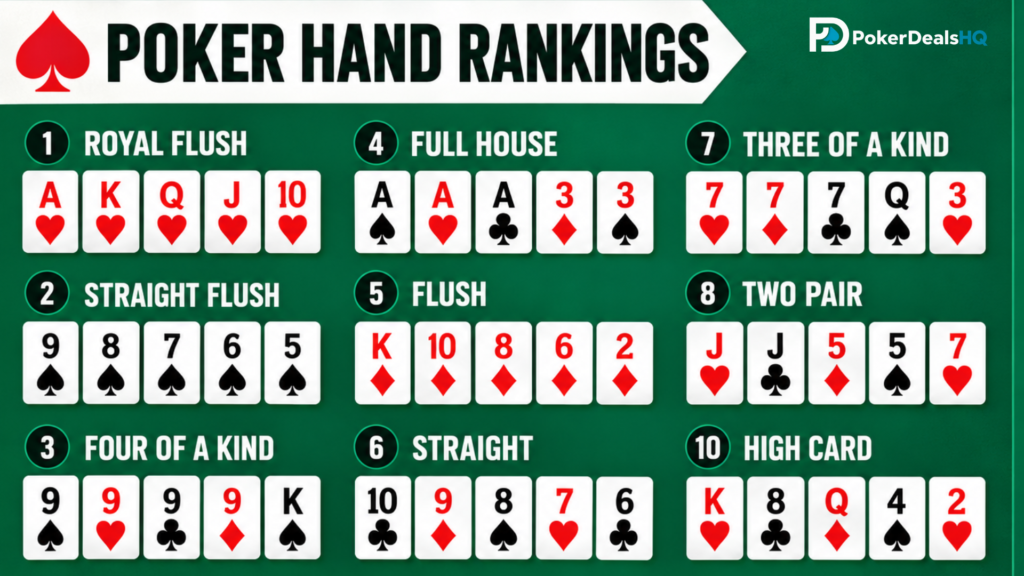
It is important to use this table because it provides specific examples of ten poker hands ranging from the strongest one to the weakest one. They include suits, which cannot be ranked relative to each other during any poker game. If two players receive a flush of different suits, they will compare ranks rather than suits.
| Rank | Hand | Example |
|---|---|---|
| 1 | Royal flush | A♠ K♠ Q♠ J♠ 10♠, the ace-high straight in one suit |
| 2 | Straight flush | 9♥ 8♥ 7♥ 6♥ 5♥, five consecutive cards, one suit |
| 3 | Four of a kind | J♣ J♦ J♠ J♥ 5♦, all four cards of one rank |
| 4 | Full house | Q♠ Q♥ Q♦ 5♣ 5♥, three of a kind plus a pair |
| 5 | Flush | A♣ J♣ 8♣ 4♣ 2♣, five cards of the same suit, not consecutive |
| 6 | Straight | 10♦ 9♠ 8♣ 7♥ 6♦, five consecutive ranks, mixed suits |
| 7 | Three of a kind | 10♠ 10♦ 10♣ 6♥ A♠, three cards of one rank |
| 8 | Two pair | 8♠ 8♦ 5♣ 5♥ 3♠, two different pairs |
| 9 | One pair | 4♥ 4♠ K♠ 10♦ 5♠, two cards of the same rank |
| 10 | High card | A♣ J♦ 8♠ 6♣ 3♥, no matching pattern at all |
The Pattern Behind the Ranking
The poker hands order follows an established hierarchy. A straight flush comprises five consecutive cards of the same suit. This combination outranks any flush and straight. A full house is composed of three matching cards and two other matching cards. In turn, it outranks any three of a kind and two pair.
It is our belief that knowing the components of poker combinations can simplify memorizing their ranking. However, it should be noted that rankings are not based on the number of combinations of components but rather on their comparative power.
One Mnemonic That Locks in the Order
The easiest way to remember the ranking order is to go from the highest rank to the lowest one: Royal Flush, Straight Flush, Four of a Kind, Full House, Flush, Straight, Three of a Kind, Two Pair, One Pair, and High Card.
There are two specific cases that may prove essential in practice. It’s important to understand that Flush outranks Straight, and Full House outranks Flush. Many new players face problems understanding these two pairs of hand types. Remembering it can make it easier to determine which hand wins.
Poker Hand Odds: How Rare Is Each Hand?
An analysis of probabilities can help players better understand poker hand rankings. For instance, in Texas Hold’em, the probability of obtaining a full house among seven cards is about 2.6%.
The table below compares the probabilities of getting different poker hands in five-card draw and Texas Hold’em, where players form their best five-card combination from seven available cards.
| Hand | Five-card hand probability | Texas Hold’em (best five of seven) |
|---|---|---|
| Royal flush | 0.000154% | 0.0032% |
| Straight flush | 0.00139% | 0.0279% |
| Four of a kind | 0.0240% | 0.168% |
| Full house | 0.1441% | 2.60% |
| Flush | 0.1965% | 3.03% |
| Straight | 0.3925% | 4.62% |
| Three of a kind | 2.1128% | 4.83% |
| Two pair | 4.7539% | 23.5% |
| One pair | 42.2569% | 43.8% |
| High card | 50.1177% | 17.4% |
The probability value for high card is the most unusual among those provided above. According to the statistics for 5-card draw poker, slightly more than 50 percent of all possible combinations consist of cards that neither form pairs nor a sequence. If we consider Texas Hold’em poker, this proportion amounts to only 17.4% due to seven used cards.
What immediately follows is the fact that the one pair turns into the combination most often seen in Hold’em–it is achieved in 43.8 percent of cases. Nevertheless, we must note that such figures do not relate to the frequency of winning but rather describe how often different poker hands occur.
Poker Hand Rankings vs Starting Hand Strength
A poker hand ranking chart is used for determining ranks in order to compare hand strengths during showdowns. At the same time, starting hands ranking is used to decide which pocket cards are worth being involved in pre-flop action. Two skills are entirely different, and beginners often get confused.
The same card combination might appear very attractive while preflop, but the real worth will depend on additional aspects, including table position or number of players sitting at the table. In case you need additional information concerning Poker Positions Explained, visit our page.
How to Make the Best Five-Card Hand in Texas Hold’em
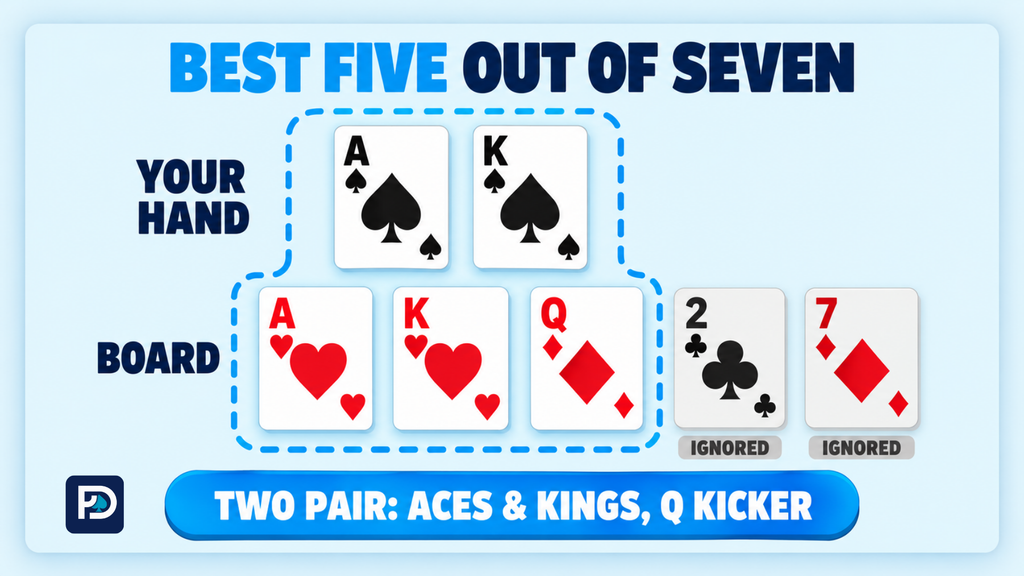
Players playing Texas Hold’em poker get two private cards referred to as “hole cards” whereas five community cards are dealt to the table. The aim of the game is to create a strong combination of five out of the total seven available cards.
It should be noted that in the Texas Hold’em ranking, there is no necessity for the player to use both his/her hole cards. Two, one, or no cards can be used.
For instance, take the following scenario into consideration:
- Hole cards: A♠ K♦
- Board cards: A♥ K♣ 7♠ 4♦ 2♥
- Best five-card hand: A♠ A♥ K♦ K♣ 7♠
In this scenario, you have a pair of aces and another pair of kings; the kicker card here is a seven. In this scenario, even though there are seven cards that can be used for the hand, only the best five cards are taken into account.
On some occasions, the best combination possible is already there on the board. For example, if the board consists of the cards 10♠ J♠ Q♠ K♠ A♠, every player still holding on to their cards has a royal flush. Since no player can make a better hand than this, the pot will be split equally among the players left in the game.
Besides that, it is important to know how to select the best five cards for comparing poker hands.
How to Compare Poker Hands: Kickers and Tiebreakers
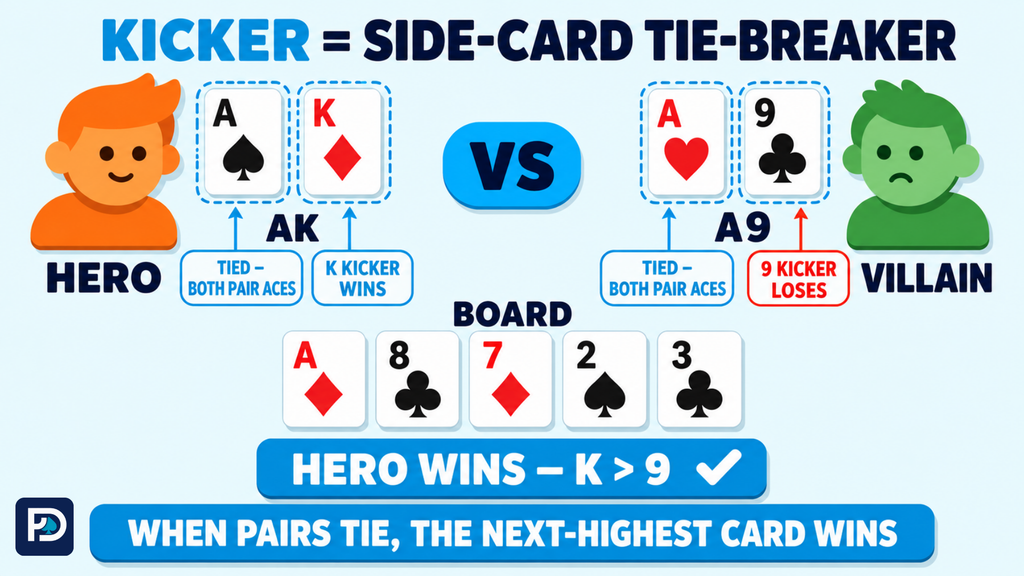
In cases where there are two players whose poker hands are of the same kind, then the winner is established through a comparison of the values of the cards in their five-card combination. It’s important to know what poker hands beat what in poker, but it’s equally important to know how to break ties.
Are these ranking criteria influenced by the character of the poker hand?
- Pair: The player with the higher pair wins. If the two pairs are equal, the highest kicker will decide who wins.
- Two pairs: Here, first, the best pair will be considered; second, the second best pair follows next. If there is still equality between the two, the highest fifth card decides.
- Three of a Kind: The three of a kind with the highest matching cards beats the others. In a situation where the three-of-a-kind match in quality for both players, the highest kicker wins.
- Full House: First, the three of a kind is compared. If both players’ three matching ranks match, the highest pair wins.
- Flush: Players have to begin evaluating which player’s cards are stronger by checking the highest card first and going down sequentially until the difference is revealed. Suits don’t play any role here.
- Straight: The better straight wins the game, regardless of suits. For instance, king high straight beats queen high straight.
- Four of a Kind: The winner will be determined by the higher four matching cards. However, if there is equality between the two, the kicker becomes relevant.
How Does a Poker Kicker Work?
A poker kicker is used to decide the winner when two players have the same type of hand. With one pair, two pair, or three of a kind, the remaining cards can determine who takes the pot.
Here is an example involving a pair of aces in Texas Hold’em:
| Handy Types | Player 1 | Player 2 |
|---|---|---|
| Hole cards | A♠ Q♦ | A♦ J♣ |
| Community cards | A♥ 8♣ 5♠ 2♦ 3♥ | Same board |
| Best hand | A♠ A♥ Q♦ 8♣ 5♠ | A♦ A♥ J♣ 8♣ 5♠ |
In this case, Player 1 has won due to the kicker–queen beats the jack. Five cards in the best possible hand always matter here. Additional sixth/seventh cards cannot affect a decision once the strongest five-card hands match each other.
It means that memorizing poker hands ranking alone does not help compare two hands. Players should understand under what circumstances it means that a main combination is a tie and what additional cards decide who wins.
Ace-High and Ace-Low Straights, Ties and Split Pots
In poker, the ace card can play as both high and low to make a straight hand combination. Sometimes this confuses novice players while they compare different combinations, including an ace.
An ace-high straight, or Broadway, is formed by 10-J-Q-K-A cards. An ace-low straight, also referred to as a wheel, is made up of A-2-3-4-5 cards. Still, the ace cannot bridge the middle part of a sequence. Thus, combinations such as Q-K-A-2-3 cannot form a straight.
| Straight type | Example | Highest card |
|---|---|---|
| Ace-high (Broadway) | 10♠ J♦ Q♣ K♥ A♠ | Ace |
| Ace-low (Wheel) | A♥ 2♣ 3♦ 4♠ 5♥ | Five |
| Six-high | 2♠ 3♥ 4♣ 5♦ 6♠ | Six |
An ace-low straight loses to a higher straight despite having an ace.
When Do Poker Hands Tie?
In case two poker hands feature identical five-card combinations, then the results will be tied regardless of suits. Any sixth and seventh cards are completely irrelevant here. Example:
- Player 1: K-K-A-Q-9.
- Player 2: K-K-A-Q-9.
- Community cards: K♠ K♦ Q♥ 7♣ 2♠
Neither of these players possesses a superior kicker card. Hence, the game is a tie.
How Do Split Pots Work?
In such cases, players divide the entire amount into equal portions (the split pot), depending on how many players received similar combinations according to the regulations for handling indivisible chips in certain games.
Sometimes such a situation may occur because the best combination has been played out on the table itself. Imagine that all community cards show 10♠ J♠ Q♠ K♠ A♠. In other words, everyone holding the remaining two pocket cards in their hand holds a royal flush.
Understanding when there are ties is no less significant than knowing what poker hands beat what, especially in Texas Hold’em, where players receive identical sets of community cards.
Poker Hand Recognition Examples
Hand ranking knowledge is easy enough, however recognizing various combinations becomes tricky once multiple cards appear on the table. The check lists in this section contain three tasks that will enable you to identify various poker hands and learn which combinations win in Texas Hold’em.
Scenario 1: Flush or Straight?
- Your hole cards: K♥ Q♥
- Community cards: 10♥ J♥ 2♠ 5♥ 9♣
Question: What’s your strongest five-card hand?
Answer: King-high flush.
Hand: K♥ Q♥ J♥ 10♥ 5♥
This hand is composed of a king-high straight (9-10-J-Q-K) and a flush. The flush outranks a straight. This combination doesn’t constitute a straight flush because the card 9♣ belongs to a different suit.
Scenario 2: Three of a Kind or Full House?
- Your hole cards: 8♠ 8♦
- Community cards: 8♥ K♣ K♠ 4♦ 7♠
Question: Which hand do you hold–three of a kind or full house?
Answer: You have a full house, eights over kings.
Hand: 8♠ 8♦ 8♥ K♣ K♠
Your best hand consists of those five cards. As your hand contains a full house, which is better than three of a kind, your opponent does not beat you.
Scenario 3: Ace-Low Straight or Flush?
- Your hole cards: A♣ 5♣
- Community cards: 2♣ 3♣ 4♥ J♠ Q♦
Question: What’s your strongest poker hand?
Answer: Five-high straight (A-2-3-4-5).
The ace serves as the lowest-ranking card in your straight here. Although you hold four clubs, there must be five such cards to form a flush. As such, your straight becomes the best possible hand combination.
Of course, knowledge of poker hand ranking is essential. But you need some practice to recognize different combinations with multiple community cards.
Common Poker Hand Reading Mistakes
Since there are so many community cards dealt in the game, poker players may miss some hands even if they know hand rankings. Take a quick look at 3 common mistakes new players make:
- Note that straights don’t have to be in order on the board. What you have to do is find five cards in a sequence, regardless of order or suit.
- Overplaying top pair: So you may have the top pair, and that sounds great, but that doesn’t mean you have the strongest hand. With three cards of one suit revealed on the board, a player’s competitor may obtain a flush simply by getting two more of the same suit. Thus, a pair would rank behind such a hand.
- Misinterpreting a paired board: When players see three of the same card on the board, it can form part of a larger combination than expected. On a board of K♠ K♦ 7♥, an opponent with K♥ 7♣ has a full house.
Therefore, players need to pay attention to which seven-card combination provides the best five-card hand possible.
FAQ
Final Thoughts on Poker Hand Rankings
Once you grasp poker hand ranks’ underlying logic, this list becomes simple enough to understand. The ranking chart shows you all possible ranks’ hierarchy. The odds table will show you how frequently specific poker hand combinations occur. Knowledge of kickers’ role, straights comparison, and splitting pots also plays a part when determining hand ranking at showdown.
The examples in the practice and common mistakes sections require your attention because they deal with various hand combinations. Regardless of whether you identify a full house or compare pairs with one kicker, ranking principles never change.
Though some differences can arise based on the type of game played, this hierarchy does not depend on variations used in the game and refers only to high-standard poker.